
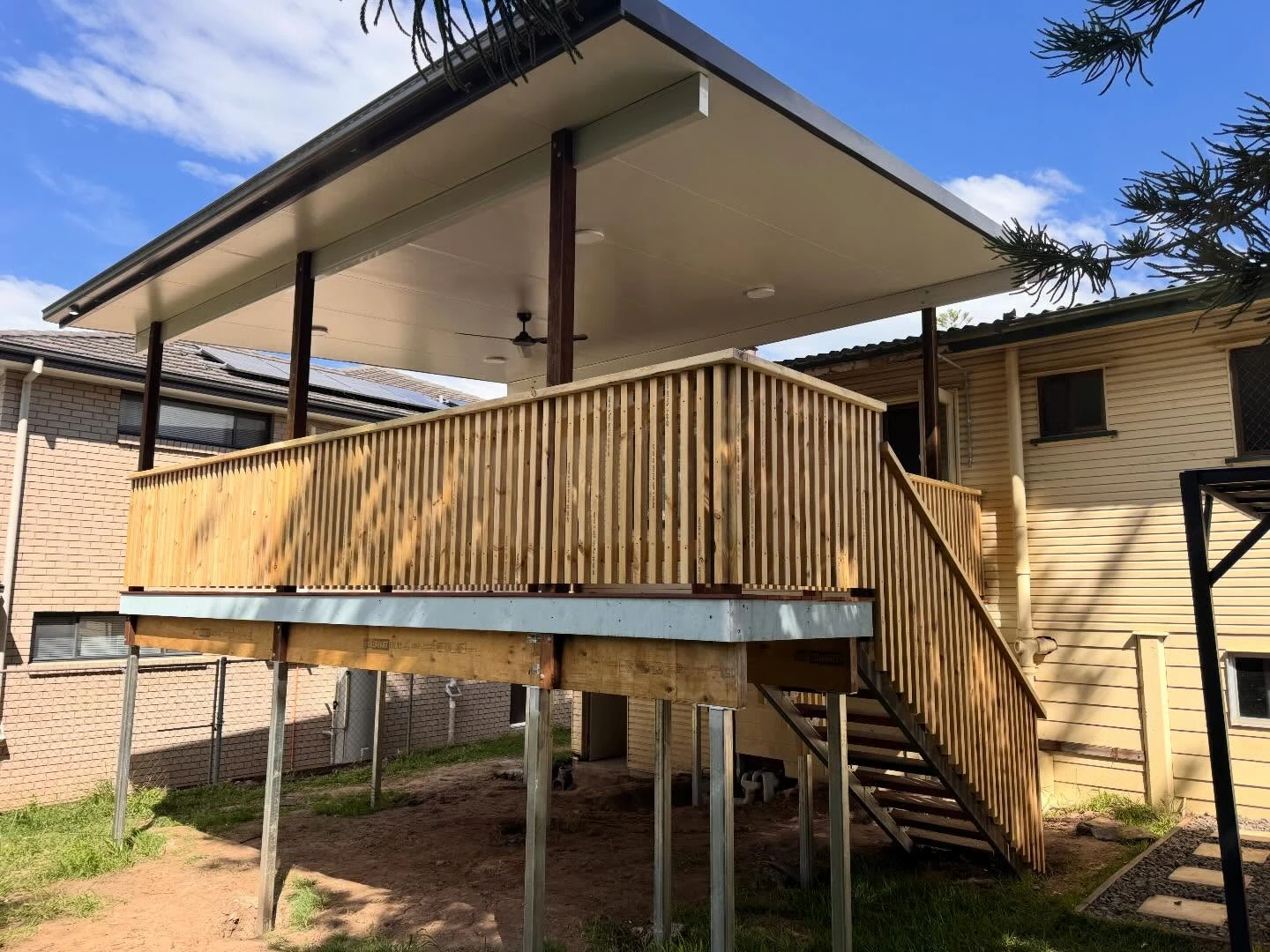
After the deck itself rather than the reading? We are deck builders in Brisbane: hardwood or composite, set out straight and quoted by Ben.
Every deck quote in Brisbane comes with the same first question: timber or composite? Both make a good deck when they are built on a sound subframe. They differ in how they look, how they age in Queensland sun and rain, what they ask of you each year, and a few things that change how the deck is built. This guide sets those differences out without a sales pitch, so the choice is yours with the facts in front of you.
Hardwood decking: what you get
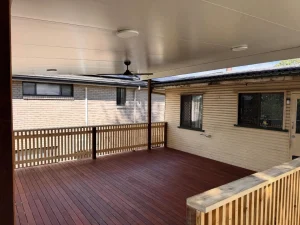
Hardwood is the traditional Brisbane deck and still the most common one we build. The species matter. Spotted gum, ironbark and tallowwood are rated Class 1 for natural durability under AS 5604, which WoodSolutions puts at more than 40 years above ground with sound detailing. Blackbutt is Class 2, at 15 to 40 years. Merbau is the common imported option; it is dense and stable but is known for bleeding colour when new, so it wants a wash-down before the first coat and care around pale paving.
Hardwood boards are usually 86 mm or 136 mm wide and 19 mm thick, laid with a small gap so water drains and the boards can move. The surface can be oiled or stained, and it can be sanded back and recoated years later, which is something composite cannot offer.
- Looks: real grain, colour variation between boards, and a surface that silvers off if it is left alone
- Upkeep: a clean and a coat of decking oil on a regular cycle, more often in full sun
- Heat: warm underfoot on a hot day, but cooler than most dark composite boards
- Repairs: a single damaged board can be lifted and replaced, and the whole deck can be sanded and recoated
- Bushfire: blackbutt, spotted gum, ironbark and merbau are among the species AS 3959 lists as bushfire-resisting timbers for lower bushfire attack levels
Composite decking: what you get
Composite boards are a mix of wood fibre and plastic, and most current boards carry a capped face that resists stains and fading. They are made to a set colour and width, usually around 135 to 140 mm wide, and many use a concealed clip fixing so no screw heads show on the surface.
The appeal is the upkeep. A composite deck is washed, not oiled, and it does not grey off. The trade-offs are physical. Composite moves more with heat than hardwood does, so the gaps at board ends and the joist spacing come from the manufacturer's span table rather than timber habits, and those tables often call for closer joist centres than a hardwood deck. Darker boards get hot in full sun. A badly scratched or burnt board cannot be sanded back; it is replaced.
- Looks: an even, repeatable finish in a chosen colour; the better boards carry a grain pattern, the cheaper ones can look flat
- Upkeep: a wash. No oiling, no sanding
- Heat: dark colours in full sun get noticeably hotter than timber
- Repairs: boards are swapped, not refinished; keep spares from the same batch so the colour matches
- Bushfire: composite boards need the manufacturer's own test certificate for the bushfire attack level of your site
Side by side
- First look: timber wins for people who want the real thing; composite wins for a uniform, modern finish
- After ten years: an oiled hardwood deck still looks like timber, a neglected one has gone grey; a composite deck looks much as it did on day one, with some fading on the cheaper boards
- Your time each year: hardwood asks for a weekend; composite asks for a hose
- Barefoot in January: hardwood is warm, dark composite is hot, pale composite sits in between
- Damage: hardwood is repaired in place; composite is replaced board by board
- Movement: both move; composite moves more lengthways with heat, so it needs the gaps its maker specifies
- The subframe: the same either way, treated pine or hardwood on galvanised or stainless fixings, except that composite often wants closer joists
Which suits a Brisbane home?
The house usually decides. A Queenslander, a post-war high-set or any home with timber character looks right with a hardwood deck, and a timber balustrade to match. A rendered or brick home, a rental, a holiday house or a deck that nobody wants to oil again leans composite. Shade matters too: a deck under a roof or on the southern side stays cooler and keeps its finish longer whichever board you choose, while a west-facing deck in full sun is where hardwood needs the most upkeep and dark composite gets hottest.
Mixing is common. We build composite decks with hardwood posts and handrails, and hardwood decks under a new roof, so the choice does not have to be all one or the other.
What the choice changes in the build
- Joist spacing: hardwood boards are commonly laid on joists at 450 mm centres; composite brands set their own, often closer, and the warranty depends on following them
- Gaps: hardwood gets a drainage gap between boards; composite gets that plus the end gaps the maker specifies for heat movement
- Fixings: hardwood is face-screwed with stainless or galvanised decking screws; composite is usually clipped into a groove
- Balustrades and stairs: the same code applies to both. Any fall of 1 m or more needs a balustrade with no gap a 125 mm ball can pass through, under the National Construction Code barrier provisions
- Approval: the board does not change whether the deck needs building approval; size, height and roofing do. Our approval guide goes through the checks
Our decking calculator works out the board rows, lineal metres and joist count for either material once you know the deck size and the board width.
What drives the quote
We do not publish deck prices, because no two decks are the same job. What moves the quote is the size of the deck, its height off the ground and what that means for posts, footings and a balustrade, the board you choose, whether stairs or a roof are part of it, access to the site, and whether the job needs approval. Composite boards generally cost more to buy than hardwood boards and ask less of you afterwards; hardwood costs less up front and more in weekends. Ben walks the site, talks through both options against the house and your budget, and gives you a written quote for the deck you actually want.
If you are ready for that conversation, see our deck building service in Brisbane. If you are still weighing it up, our timber deck guide goes deeper on choosing a hardwood, and the deck renovation guide covers what to do with the deck you already have.
More guides from the tools
- Deck Building Tips for Brisbane Homes
- Deck Renovation Brisbane Guide: Repair, Restore or Rebuild
- Deck Staining & Sealing Brisbane Homeowners Can’t Ignore
Planning the job itself? Start with our deck building service page.